STARVUE Software
Unlock unprecedented insights into the tumor microenvironment and accelerate your breakthroughs with STARVUE™, the intuitive single-cell spatial analysis platform.
AI-Powered Spatial Insights, Simplified

High-Throughput Image Processing
Accelerate analysis with cloud-based automation that processes hundreds of images in parallel and increases throughput by up to 100x.

Effortless High-Confidence Insights
Leverage deep learning models that adapt to biomarker, artifact, and tissue variability, delivering robust AI-powered cell classification.

Flexible Spatial Analysis
Focus on sub-populations of interest by quickly defining custom phenotypes and regions of interest.

Collaborative Web Portal
Access data easily through a secure, cloud-based platform that enables flexible collaboration and downstream analysis.

Quantitative Spatial Biology Insights
Quantify cell populations, co-expression, and proximity to reveal immune and tumor cell interactions.

InSituPlex® Assay Integration
Integrate seamlessly with OmniVUE™ and U-VUE® assay data to eliminate workflow compatibility issues.
Meet STARVUE

One connected ecosystem from tissue imaging to AI-powered interpretation.
STARVUE™ transforms multiplex immunofluorescence data into actionable spatial insights through a unified workflow that combines imaging, AI analysis, and quantitative reporting. Each step, from signal generation with InSituPlex® assays to image co-registration, analysis, and third-party integration, is optimized for precision and scalability, producing reproducible single-cell spatial analysis at scale.
End-to-End Workflow for Advanced Spatial Image Analysis

mIF and H&E Image Acquisition
Capture high-resolution images from InSituPlex® assays that use proprietary isometric, single-molecule signal-amplification chemistry directly correlating signal intensity with target biomarker count. Add optional same-section H&E staining for complementary morphology.


UltiStacker.AI™: Automated Co-Registration
Align multiplex and H&E images using UltiStacker.AI™, which performs high-throughput co-registration of whole-slide InSituPlex® 8- or 12-plex biomarker assay images. Ensure accurate spatial correspondence across large tissue areas.

UltiAnalyzer.AI™: Cell Segmentation and Phenotyping
Analyze biomarkers within composite whole-slide mIF images at scale with UltiAnalyzer.AI™. Apply deep-learning models to generate cell-level quantitative data based on morphology and detected signal intensity for robust phenotyping.


Data Review in Omero Plus
Integrate findings with third-party data management and analytics platforms to enable deeper characterization. Validate results, perform cross-sample comparisons, and extend insights into broader bioinformatics pipelines.
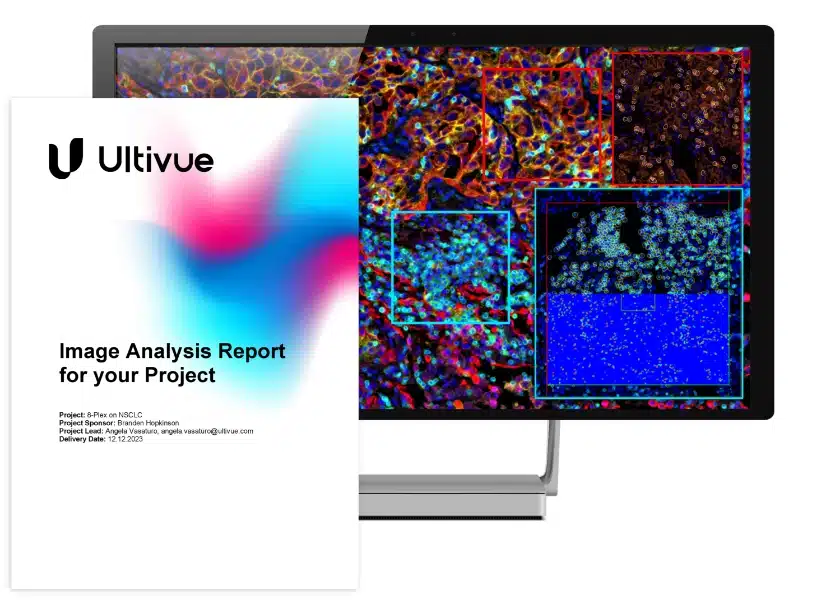
Spatial Insights and Reporting
Generate quantitative spatial outputs, including cell-density maps, co-expression profiles, and proximity analyses, accessible through STARVUE™’s secure cloud portal for collaborative exploration.

Advanced Cohort-Level Analysis
Combine datasets across samples and studies to evaluate treatment effects, biomarker variability, and disease heterogeneity using Vizgen’s spatial phenomics tools for translational and clinical discovery.

Scalable Cloud Infrastructure
Process large spatial datasets securely with AWS-based computing built for enterprise-grade performance.

Data Integrity and Traceability
Maintain consistent versioning, audit trails, and metadata tracking across all analysis workflows.

Quantitative Data Outputs
Export standardized, machine-readable datasets for downstream bioinformatics and single-cell spatial analysis pipelines.

Interoperability Across Platforms
Integrate STARVUE™ results seamlessly with third-party analytics and visualization tools.

Advanced Data Security
Protect research data through encrypted storage, controlled access, and compliance with global security standards.
Integrated, Full Lifecycle Spatial Analysis

Connect, analyze, and visualize every step of spatial biology in one unified ecosystem.
Gain powerful insights through an integrated ecosystem that streamlines your entire workflow from image management to in-depth analysis, all within a unified platform. STARVUE™ leverages AWS cloud infrastructure to power your spatial biology analysis. Concentriq allows you to document, manage, and visualize your whole slide stained images. Once analyzed, seamlessly transition to Omero Plus to explore the AI-identified cells, markers, and phenotypes to power next-generation single-cell spatial analysis.
- Ensure data integrity across workflows
- Collaborate seamlessly across teams
- Centralize image review and analysis
Comprehensive Data Package
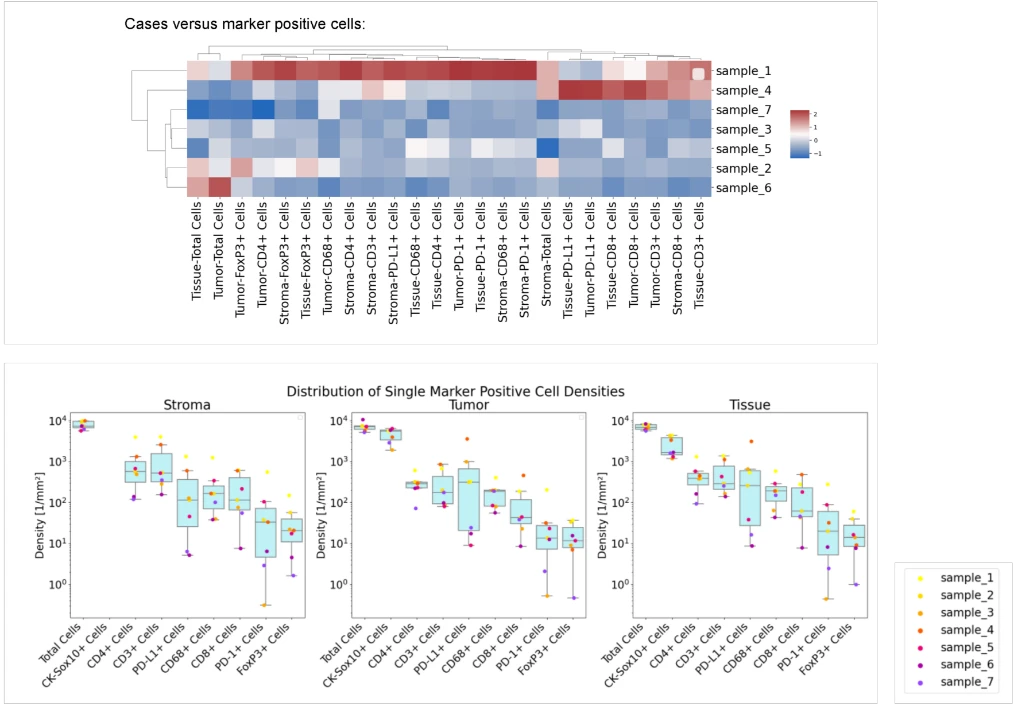
Access structured, machine-readable outputs for downstream spatial analysis.
STARVUE™ delivers a complete suite of quantitative outputs designed for deeper, reproducible analysis. Each dataset supports manual review, downstream integration, and advanced spatial exploration.
- Slide-level statistics optimized for seamless manual examination
- Machine-readable data tables compatible with downstream data analysis tools
- Cell-level data provided for further exploration
- Spatial phenomics report for advanced spatial or cohort-level analysis (available add-on)