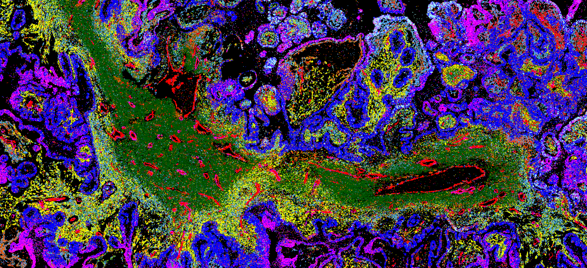
Cancer - Tumor Profiling

Power your tumor profiling with MERFISH 2.0™ and OmniVUE™ assays, a comprehensive spatial multiomic approach that reveals cellular heterogeneity and immune architecture within the tumor microenvironment.

Tumor heterogeneity poses a major challenge in understanding disease mechanisms. Integrating RNA and protein views provides a more complete picture of cellular diversity and molecular pathways.

MERSCOPE Ultra™, using MERFISH 2.0™ technology, maps single-molecule transcripts and cell types across whole sections. OmniVUE™ multiplex immunofluorescence quantifies checkpoint and activation proteins in the same study design, enabling phenotypes and cell–cell proximity analyses. Together, these data connect mechanism to response for actionable tumor profiling, enhancing insight into cellular composition, tumor biology, and treatment response to better inform patient outcomes.

Contact Us for More Information

High-resolution whole tumor profiling in single-cell detail

Explore the capabilities of MERSCOPE® inside our human immuno-oncology data release. The platform uses formalin-fixed paraffin-embedded (FFPE) cancer samples to perform single-cell spatial transcriptomics. This release also features 16 MERFISH datasets across eight human tumor types, including two colon, two liver, two melanoma, four ovarian, two prostate, two lung, one breast, and one uterine cancer sample(s).

Each dataset features the analysis of 500 genes to represent about 4 billion transcripts within 9 million cells in total. This robust dataset allows you to delve into detailed immune cell characterization within the tumor microenvironment. Access this rich dataset to see how MERFISH can perform high multiplexing, high-resolution single-cell, and spatial genomics analysis for your FFPE samples.

Explore Data
Image
Image

High-throughput phenotyping and imaging of the TME using the FlexVUE immunofluorescence assay

Discover how Vizgen’s FlexVUE™ multiplex immunofluorescence streamlines tumor profiling through high-throughput phenotyping and quantitative spatial analysis.

The assay enables simultaneous detection of multiple biomarkers within a single FFPE section, preserving tissue, improving reproducibility, and accelerating translational insights.

Learn how this workflow integrates imaging automation and standardized protocols to deliver reproducible, publication-quality spatial proteomics data.

Download E-Book

Pioneering the Next Era of Spatial Biology with MERFISH 2.0 and the MERSCOPE Ultra Platform

Explore the next generation of spatial transcriptomics with MERFISH 2.0™ on the MERSCOPE Ultra™ platform. This webinar introduces advances in chemistry, workflow automation, and imaging that boost sensitivity up to 8× and expand gene-panel capacity to 1,000 targets. Hear from Vizgen scientists as they share real-world datasets, discuss improvements in FFPE compatibility, and demonstrate how MERFISH 2.0 provides single-cell resolution and reproducible spatial imaging across tissues.

Watch Webinar
Image

Quantify Tens of Thousands of Transcripts and Their Cellular Locations Across the Whole Tumor

Profile tumor, immune, and stromal compartments with MERFISH 2.0™ pre-designed panels, optimized to reveal spatial gene expression and cellular organization across diverse cancers.

The MERFISH 2.0 Pre-designed Cancer Panels enable researchers to deeply profile the tumor microenvironment with ready-to-run gene sets curated to capture expression across tumor, immune, and stromal compartments at single-cell resolution.

  • MERSCOPE™ Human Immuno-Oncology Panel, 815 genes (v2.0): Offers comprehensive coverage of pathways driving tumor–immune interactions, enabling detailed characterization of immune activation, suppression, and infiltration.
  • MERSCOPE™ Human Breast Cancer Panel, 815 genes (v2.0): Focuses on epithelial diversity, immune infiltration, and stromal remodeling to illuminate cellular states and spatial organization within the breast tumor microenvironment.

Together, they help researchers quantify transcript abundance across thousands of cells, detect rare cell states, and study treatment-driven transcriptional changes. By mapping gene expression in situ, scientists gain a deeper understanding of tumor heterogeneity and can design more targeted, spatially informed therapeutic strategies.

Image

Figure: Clustered cells are spatially displayed across a Human Breast Cancer tissue section.

Likewise, you can use these panels to monitor changes within tumor cells in response to treatment. By observing genetic expression changes within different cell types of a tumor, researchers can study treatment strategies with greater precision to enhance patient outcomes. MERFISH 2.0 Pre-designed Cancer Panels offer a comprehensive solution to unravel the complexities of tumor biology and forge a new era of personalized cancer therapies.

Request a Quote

MERISH 2.0 Predesigned Panel Features

Cancer Pathway Exploration

Unlock the secrets of cancer with a two comprehensive suites of 815 genes, each revealing deep insights into canonical signaling pathways.

Characterization of Tumor Behavior

Dive into the complexity of tumor dynamics to understand progression and response mechanisms through spatial gene analysis.

Interactions in the Cancer Microenvironment

Illuminate the intricate interactions between tumor, immune, and stromal cells to reveal the full landscape of human cancers.

Broad Compatibility Across Cancer Types

Grow your research potential with a panel compatible with multiple human cancers, including breast, lung, liver, prostate, colon, ovarian, brain cancers, and melanoma.

Versatile Sample Type Integration

Leverage proven performance across fresh frozen, fixed frozen, cell culture, and FFPE samples, maximizing the potential of your research.

Image

Build better mouse studies with a practical guide to multiplex immunofluorescence for the molecular profiling of tumors. This e-book covers panel design for murine tissues, antibody selection and validation, FFPE workflow steps, imaging and analysis, and QC best practices. See examples of checkpoint and activation marker mapping in tumor models, and learn how InSituPlex® enables simultaneous detection of multiple targets on one section, conserving tissue while delivering quantitative, reproducible readouts for tumor microenvironment research.

Insights Gained from MERSCOPE Data

Observe Expression Patterns of Oncogenes Down to the Cellular Level

Using combinatorial labeling, sequential imaging, and error-resistant barcoding, MERSCOPE® allows you to observe the expression location of tens of thousands of specific genes tumor-wide, down to the single-cell scale. This variable-scale tumor profiling empowers you to observe the location of your gene of interest within individual cells and detect heterogeneity within a whole tumor in staggering detail.

Image

Figure A: Spatial distribution of select genes, including ACTA2 (green), CD3D (red), LGR5 (light green), MKI67 (magenta), and PECAM1 (blue) from 500 genes analyzed across the tissue. Scale bar: 1mm. Figure B: Zoom-in of the boxed region in A. Scale bar: 1 mm. Figure C: Zoom-in of the boxed region in B, with cell boundary polygon masks shown in grey. Scale bar: 250 µm.

Map the Spatial Distribution of Cell Types Across Tumors

MERSCOPE® offers a clear assessment of tumor development by showing you the arrangement of specific cell types within the tumor microenvironment of any tumor type. Many sample types are compatible with MERSCOPE®, including fresh frozen, fixed frozen, cell culture, and even FFPE samples. Our goal is to make data like this possible for your samples.

Image

Figure: FFPE cancer samples, including breast cancer, colon cancer, melanoma, lung cancer, liver cancer, ovarian cancer, prostate cancer, and uterine cancer, were analyzed by MERSCOPE® using the Human Immuno-Oncology predesigned panel together with the cell boundary staining kit to label the cell boundary. Cells are segmented and subjected to single-cell analysis. Identified cells in each sample are colored to show the spatial distribution of different cells across the sample. Scale bar: 1mm.

High Accuracy and Reproducibility

Have confidence in the results of your tumor profiling efforts. MERSCOPE data is highly accurate, as shown by high correlation between counts from replicates from the same tumor and a strong correlation between MERFISH counts and bulk RNA-seq. Map tumor expression with transcript quantification measurements you can rely on.

Image

Figure A: Correlation of MERSCOPE® data between two human ovarian cancer slices from the same patient. The correlation coefficient is 0.99, indicating the measurement is highly reproducible.
Figure B: Correlation analysis between MERFISH counts and FPKM values from bulk RNA sequencing on Human Ovarian Cancer 1. The correlation coefficient is 0.82, indicating the measurement is highly accurate.

Crafting a gene panel that targets the intricate mechanisms of cancer biology demands both precision and a deep understanding of oncogenic processes. The MERSCOPE® Human Immuno-Oncology Panel, 815 Gene (v2.0) provides a comprehensive MERFISH® 2.0–optimized gene set designed to profile key cellular compartments across the tumor microenvironment, including T-cell and myeloid activation states, antigen-presentation pathways, epithelial remodeling programs, and stromal signaling networks. This updated panel enables high-plex spatial transcriptomics with improved chemistry performance, empowering researchers to map cellular interactions, characterize therapeutic response mechanisms, and reveal immune-driven heterogeneity with single-cell resolution.

Publications

The MERSCOPE® platform produces subcellular spatial transcriptomic data for whole tissue sections, making it ideal for tumor profiling. This empowers researchers and clinicians to assess the heterogeneity within a cross-sectional tumor sample, quantify oncogenes of interest, and predict tumor development.

Top